JITX and Cherry Blossom share an unusual idea: a circuit board should be written as code, not drawn. They differ on who writes it. JITX gives engineers a Python environment in VS Code, with AI proposing edits. In Cherry Blossom an agent writes the code from a plain-English description, and you never have to read it.
By Arnaud and Anass·
The short answer
The best JITX alternative is Cherry Blossom if you want a board written as code without writing any of it: you describe the board in plain English, an agent writes it as tscircuit code in a cloud sandbox and builds it, and a verification gate checks it before you order.
There is no IDE or Python to install, proprietary boards are fine on a monthly plan, and the board exports as an editable KiCad project.
JITX suits engineers who want to write the Python themselves for demanding high-frequency boards, with HFSS simulation setup, and who can use the open-source plan or an Enterprise contract.
The reasons
Why look for a JITX alternative?
JITX asks two things of you. The first is code: designs are Python, written in Visual Studio Code, and its installation guide asks for Python 3.12 or later. The second is either an open licence or a sales conversation. The free plan is only for open-source designs under CERN OHL-Permissive v2, and a proprietary board needs the Enterprise plan, priced by quote.
If you do not want to program your board, or your design is closed-source and small enough that an enterprise contract makes no sense, those two requirements are the reason to look elsewhere. Cherry Blossom is built for hardware engineers and startups in that position.
The difference
Who writes the code?
JITX sums up its approach as "Requirements become Python. The AI edits the code. JITX generates a candidate design." Its homepage lists schematics, board structures, pin assignments and routing among the outputs, plus HFSS simulation setup and dispatch, and says it runs on your infrastructure with your approved AI. Its installation guide says JITX ships as a Visual Studio Code extension and needs Python 3.12 or later, on macOS, Linux or Windows.
Cherry Blossom also stores the board as code, written in tscircuit, but you do not write it. An agent in a cloud sandbox writes it from your description, builds it, and shows the schematic, PCB, 3D view and BOM. You change the board by asking the agent. Footprints come from real part data, and every AI edit passes a verification gate.
So the two expect different people at the keyboard. JITX assumes you are comfortable in an IDE and want precise control. Cherry Blossom assumes you would rather talk about the board than program it.
We built one
What can go wrong when a board is written as code?
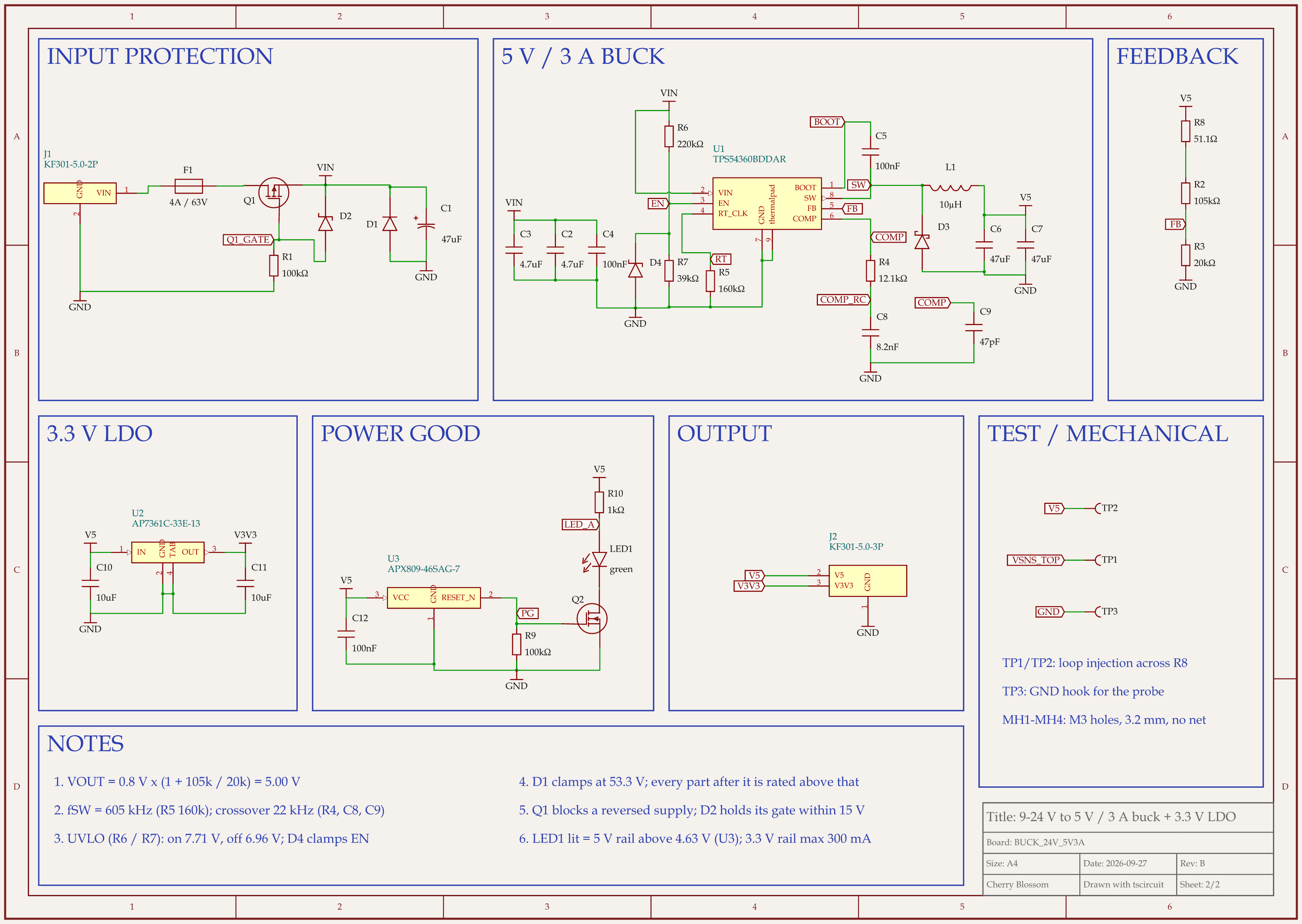
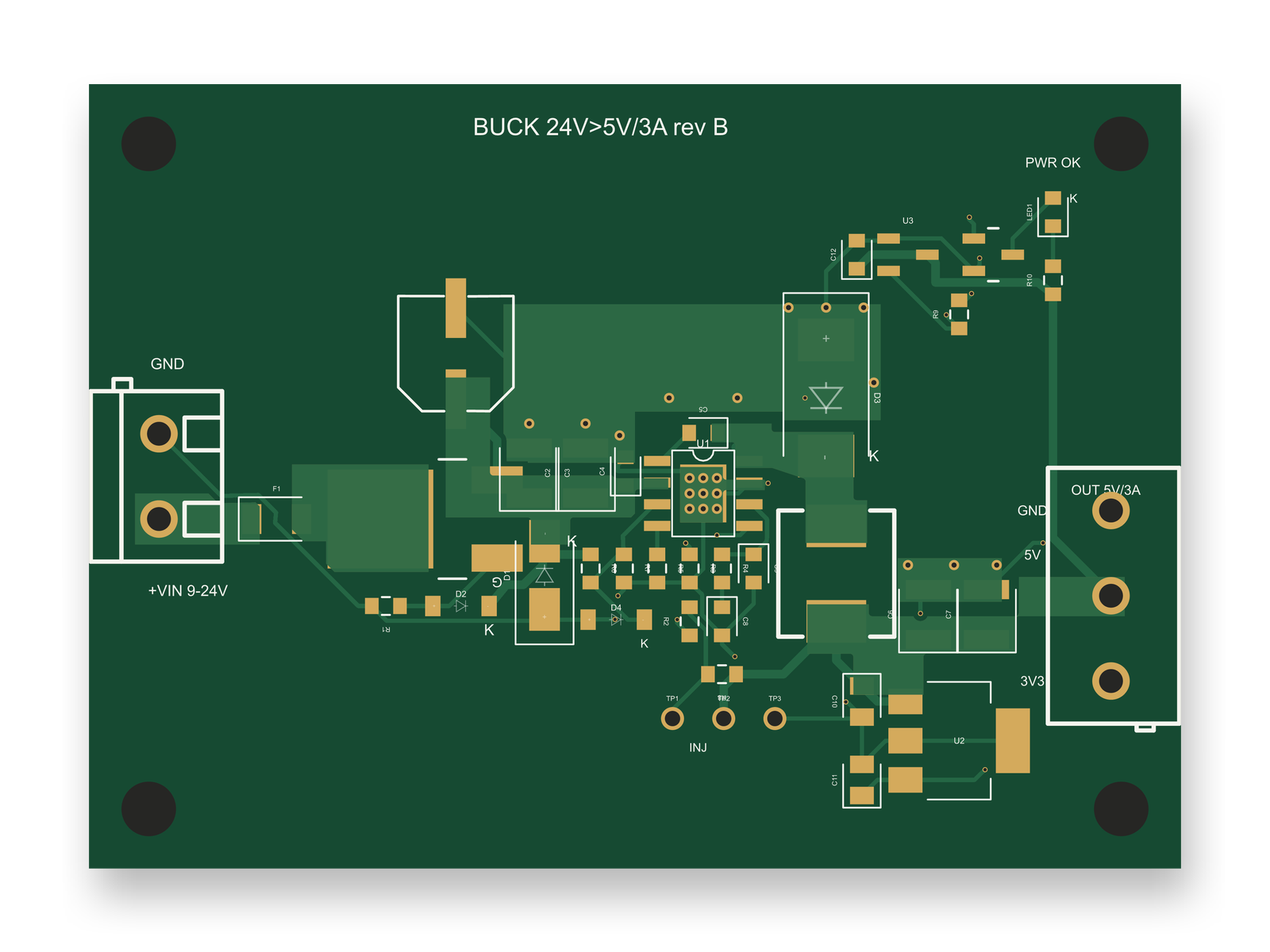
Rev B of a 24 V to 5 V, 3 A buck board that an AI agent wrote as tscircuit code: schematic and PCB.
An AI agent wrote this 9 to 24 V in, 5 V at 3 A supply as tscircuit code, the open-source engine Cherry Blossom runs on. It ran on our own machine, with the same version and review tool as Cherry Blossom's agent. Code made some parts easy: each value was computed from TI's datasheet equations, and a full rebuild with routing took 73 seconds, with other boards building on the same machine.
Code also carried a quiet mistake. tscircuit's generic MOSFET numbers its pins 1, 2 and 3 as drain, source and gate, which matches neither transistor on this board. Left alone, it would have put the reverse-polarity MOSFET's gate on its drain pad. It was found in round 1 and fixed with footprints whose pads are named drain, source and gate. The stock diode footprints carry no cathode mark either, so each diode got a printed K.
Those fixes leave work for a person. The custom footprints render with no 3D body, and the fab's rotation for the MOSFETs and diodes needs a manual check before assembly. Code also made the last fix easy to check. When an outside review added a zener diode to the enable pin, a diff of every net, part and position against the previous build showed that change and nothing else. The circuit ended at 86 out of 100 in that review, the layout at 88, and the board has not been fabricated.
KiCad and Altium integration; Siemens Xpedition on Enterprise
Pricing
Free editor; AI from $20/mo Pro, $140/mo Ultra
Free for open-source designs; Enterprise by quote
JITX details from jitx.com, jitx.com/plans and its installation guide, September 2026.
Cost
What does each one cost?
JITX's plans page has two tiers. Free and Open is free indefinitely, with unlimited design complexity and KiCad and Altium integration, but only for open-source designs under the CERN OHL-Permissive v2 licence; proprietary designs are not allowed on it. Enterprise adds proprietary designs, PLM integration, Siemens Xpedition, air-gapped or locally hosted installation and dedicated support, at a price you get from sales.
The Free plan is the full editor, by hand, with no AI. Pro adds the AI for $20 a month, with 4M AI credits and 600 AI actions a day. Ultra is $140 a month with 32M credits and the frontier models. Usage past the allowance is $5 per 1M credits, only if you turn it on. There is no API key to connect and no per-seat licence.

The catch to notice: if your board is closed-source, JITX's free plan does not cover it.
Who should stay
When is JITX the better choice?
JITX can be the better fit for this kind of work.
You are designing a demanding high-frequency board and need simulation in the loop.
You want to write and review the design code yourself, with full control.
Your company requires the tool and the AI to run on its own infrastructure, or air-gapped.
Who should switch
When is Cherry Blossom the better choice, and how do you start?
You do not want to write or maintain code.
You want to start in a browser without installing an IDE or Python.
Your board is proprietary and small, and you want a monthly plan rather than an enterprise contract.
You want fab files and a PCBWay ordering hand-off from the same place.
JITX starts from requirements that become Python. Cherry Blossom starts from the same requirements written as plain English, so your first message is simply what the board has to do. The agent writes the tscircuit code, builds the board, and takes further changes in the same chat. You never have to write a line of it, and the result exports to KiCad as an editable project.
Current limits. Cherry Blossom is an early beta. You change a board by asking the agent, not by dragging traces yourself, so fine manual layout happens after a KiCad export. It is not a circuit simulator, it has no real-time multi-user editing, and it is not built for high-speed or RF sign-off.
Everything else
Where do both sit among AI PCB tools?
1Cherry BlossomOur product
Best for: Going from a plain-English description to a fab-ready board, in the browser
You describe the board in plain English and an AI agent writes it as code, builds it, and shows you the schematic, PCB layout, 3D view and BOM. Footprints come from real part data, and a verification gate checks the board before you can order it. Export Gerbers, an editable KiCad project, a BOM and pick-and-place files, or open Circuit JSON.
Platform
Browser, nothing to install
Pricing
The Free plan is the full editor, by hand, with no AI. Pro adds the AI for $20 a month, with 4M AI credits and 600 AI actions a day. Ultra is $140 a month with 32M credits and the frontier models. Usage past the allowance is $5 per 1M credits, only if you turn it on. There is no API key to connect and no per-seat licence.
2JITX
Best for: Engineers who want to design demanding boards as Python code
A VS Code extension where requirements become Python, AI proposes edits, and JITX generates schematics, pin assignments and routing, with HFSS simulation setup and KiCad and Altium integration.
Platform
VS Code extension on macOS, Linux, Windows
Pricing
Free for open-source designs; Enterprise by quote
For boards where signal integrity decides the outcome, read our high-speed PCB design software guide, which covers the sign-off tools JITX sits beside. For a fast first prototype, Cherry Blossom gets you there sooner; for everything else, see the roundup of AI PCB design tools.
See it on your own board
The quickest way to judge any of this is to describe a board and read what comes back: the schematic, the layout, and what the verification gate says about it. It runs in the browser, with the AI included from the Pro plan up.
The best JITX alternative is Cherry Blossom if you want a board defined as code without writing the code yourself. Both tools treat a circuit board as code. JITX is a Visual Studio Code extension where engineers write the design in Python, AI proposes edits, and JITX generates schematics, pin assignments and routing. It targets high-frequency boards, sets up HFSS simulations, and its free plan is limited to open-source designs; proprietary work needs Enterprise. In Cherry Blossom, an AI agent writes the code for you from a plain-English description, in the browser, and a verification gate checks every edit against manufacturing rules before you can order. Footprints come from real part data, proprietary boards are fine on a paid monthly plan, and the result exports as an editable KiCad project. If you want to write Python for a high-speed board, JITX fits. If you want a working board fast without code, pick Cherry Blossom.
JITX's Free and Open plan is free indefinitely, but only for open-source designs licensed under CERN OHL-Permissive v2. Proprietary designs need the Enterprise plan, which is priced through sales.
JITX designs are written in Python. Its installation guide says it ships as a Visual Studio Code extension and needs Python 3.12 or later.
No. Cherry Blossom stores boards as tscircuit code, but the agent writes it. You describe the board and ask for changes in plain English.